

I want to tell you something I am proud of.
In early January, I wrote that this winter felt different—more manageable, more aligned. My body recognized the cold. I was cautiously optimistic. And then the temperature dropped to lows we haven’t seen in years, the Epstein files fast followed, and I went further down than I have been in a long time. But I did not drink.
Getting sober is one of three things that has fundamentally changed my life. The second is leaving a career I hated in order to follow what I can only call a vocation, into this work, into community, into the strange and serious business of collective waking up. The third is becoming a mother. These three things remade me.
The Epstein files did not remake me. What they did was confirm the remaking. They unveiled what had always been true. And I am grateful they dropped in winter.
Winter is already the season for descent. So this descent happened in the right time for that kind of work. Winter was the container I needed to go down down down, and come back up again.
The Myth Without Naiveté
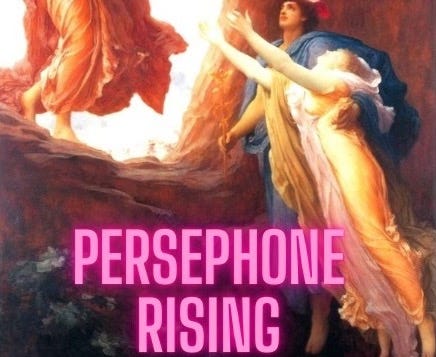
Persephone (Kore, the maiden, the unnamed girl) did not choose to go. She was taken. The earth split open and she was pulled down. Demeter grieved so absolutely that the harvest failed. The world went cold. And still, no one came quickly enough.
We have softened this myth considerably. We have turned it into a story about seasons, about cycles, about the natural necessity of darkness. All of that is true. And the abduction is also true. It is not metaphor. It is a description of what happens when a girl’s body becomes a site of someone else’s authority.
Persephone ate the pomegranate seeds. There is a reading in which this is a mistake, a trap. There is another reading in which she knows exactly what she is doing, in which the underworld is not only abduction but initiation.
I sat with both readings this winter. I do not want to romanticize harm. I want to be precise about what transforms and what simply wounds, because those are not always the same thing.
Kore: Before
Do you remember the early 1990s?
Eddie Vedder was a masculine ideal—his body moved and felt things, but it did not threaten or dominate. Hip hop was prophetic. Women had safe access to abortions and were wearing clothes that covered our bodies and were also, somehow, free.
And then (and I do not exaggerate how sudden this was) somewhere between 1996 and 1998, the floor gave out. I remember going away for a few weeks one summer and coming back to a different cultural landscape.
Britney Spears. Christina Aguilera. The whale tail. Low-rise jeans engineered to make any body without a twelve-year-old’s hip-to-waist ratio read as wrong. My burgeoning hourglass frame suddenly coded as fat.
It wasn’t gradual. It was abrupt. It was, in retrospect, an attack.
Jeffrey Epstein was operating his trafficking network throughout the 1990s. Les Wexner (founder of L Brands, owner of Victoria’s Secret, Abercrombie & Fitch, Bath & Body Works, Express, Limited) was Epstein’s primary patron. The man who handed him power of attorney over his entire financial life was simultaneously constructing what desirable meant for an entire generation of girls … while they were raping us.
Victoria’s Secret Angels on the runway. “Juicy” on our butts. The specific, surveilled, manufactured body that was supposed to be our aspiration. These were not separate projects. They were systems. Systems of extraction and control dressed in pink satin and sold as one-size-fits-all femininity.
Peers coerced me. Family coerced me. Culture coerced me. Everyone around me insisted I had to comply or I would not be lovable, not be worthy, not be desirable. The pit in my stomach told me something was wrong. The world around me told me my stomach was the problem.
No wonder I became a drunk.
The Underworld
I continued to suffer under impossible rules of femininity long after I got sober. I kept trying to metabolize a standard that was designed to be unmetabolizable. You cannot digest something that is meant to make you sick. I was trying to find what I had done wrong, what I could do better, when the answer was always structural: the standard itself was the weapon.
Resmaa Menakem writes about the body as the place where history lives—not in our minds or our ideologies, but in our tissue, our breath, our reflexes. Ruth King names racialized trauma as a legacy of undigested pain. I want to name this alongside that: what was done to women’s bodies through the beauty-industrial complex Wexner and Epstein built and profited from is also a legacy of undigested pain. It is somatic. It lives in the body. And it was not an accident.
The pit in my stomach was not anxiety. It was discernment. The intuition to push back was not a personality flaw. It was sanity. The reach for alcohol was a coherent response to cognitive dissonance so severe, so sustained, and so structurally enforced that my nervous system had no other available exit.
The Epstein files did not reveal this to me. They confirmed what my body already knew and had been trying to tell me since middle school. They gave shape to what I had been surviving.
No Mud No Lotus
I had a bad run in my late twenties. The worst period of my life. There were many reasons, and one of them is that I fell into the clutches of someone considerably less bad than Jeffrey Epstein, which given the bar Jeffrey Epstein has set for horrorshow, means he was still pretty bad.
I learned some things the hard way during that time.
I learned that people will hurt you not only because they are hurt themselves—though that is still no excuse—but because they want to. Because they enjoy it. They will lie to you and confuse you deliberately, for pleasure, and you will never be able to reach them. You cannot explain your experience in a way they will receive. You cannot get through to them no matter how hard you try. And they will hurt you for as long and as badly as they can.
Reading the Epstein files (what little I could stomach) confirmed the larger version of this. The world is run by people who want to hurt us. And when I sit with it, the logic is almost clean: of course a system built on ruthlessness selects for the most ruthless. Of course the cruelest, the greediest, the most power-hungry end up with all the gold and make all the rules. The architecture guarantees it.
Think of it this way: Ted Bundy and John Wayne Gacy are running the world. They have the money, the weapons, and the power. We know what they intend to do with it. We cannot reason with them. We cannot appeal to empathy they do not have. We cannot beg or plead or invoke rule of law—they make the law and do not follow it.
And understanding this, in its way, is liberation.
I no longer care what they think. I no longer follow their rules. I no longer waste energy trying to be in relationship with people who have decided I am prey. I follow my moral compass. I listen to my vows. I care what we are doing and how we are taking care of each other. I refuse. I resist. I survive.
In my 20s I had three options: accept it, leave, or keep fighting. I left.
But this is a global problem. So there is nowhere to run.
The Return
In ancient Athens, the Thesmophoria honored Demeter and Persephone with a women’s festival that was entirely outside male authority, rooted in agricultural time, in descent and return, in what women carry in our bodies and our grief. The spring return is not a rescue. It is a homecoming on different terms. Persephone does not come back the same. She comes back with knowledge of the dead.
That is what initiation actually means. Not that the harm was necessary. Not that we should be grateful for our scars. But that we are not the same person who went down, and the person who returns has a different kind of authority.
And so, I feel myself slowly returning like Persephone in spring. The ground is still cold here in the Hudson River Valley, but I feel the first somatic shift that happens before any visible green, before anything you can point to.
This winter was one of the hardest of my life. I have also never been prouder of myself. These two things are not in tension. The descent happened. Winter held it. I did not even want to drink. I stayed in the dark and let it transform me.
I am changed. I know what I know. I know who built the cage and I know who told me the cage was my fault and I know that the longing for escape was not weakness. It was wisdom. It was wildness. It was sovereignty. It was my body saying: RUN.
At Ostara this weekend, we mark the moment the light returns. Not the fullness of summer, just the tipping point. The day the dark and the light are equal.
I will take it. I will take the return. I will take the first crocus even when snow is still possible. This is what coming back from the underworld looks like for me. Not healed. Not resolved. Not finished. But returning. On different terms.
My Greek ancestors understood that Persephone’s return was the precondition for harvest. You cannot be reborn without death. You cannot have growth without starting in the darkness.
I have been in hell the last few months. And let me tell you, there be monsters. But I see them clearly now.
In spiritual solidarity,
🧿Constant Craving ✨
Absolutely magnificent ~ and now I want to hear about the new terms.
Thank you for sharing your journey. You’ve learned much and come far you’ll go deeper and straddle wider breadth as you continue to grow in your womanhood. But maybe you’ll stop straddling and stand surefooted united in your beliefs with like-minded people. I’d like to think I stand with you.