

The Dharma is easy enough to admire in quiet rooms. Most Western converts begin there: a cushion on the floor, a few minutes before the rest of the household wakes up, a fragile window where nothing is demanded of us. In those spaces, impermanence sounds poetic, compassion sounds safe, and the world’s brutality feels far away.
But practice comes alive in public life, where conditions are unstable, the stakes escalate, and fear arrives with enough force to reorganize our priorities.
Fear isn’t theoretical here. People are being starved, crushed, displaced, and bombarded. Neighbors are being disappeared into prisons without trial. The ground under entire nations has been turned into rubble.
Those who speak clearly about it risk professional retaliation, social punishment, or the slow erosion of institutional belonging. None of this is imagined. It’s happening in real time, to ordinary people. Under these conditions, fear is not a personal flaw. It’s a rational assessment of the world.
Fear Is Not a Failure of Practice
In early Buddhist texts, fear is simply another expression of dukkha—our vulnerability to a world that can overturn everything we rely on. The Buddha taught that beings “fear, tremble, and shrink back” because they are “bound to what is dear” (SN 42.11). Fear arises where there is clinging.
The Buddha never asked us to suppress or transcend it. In the Satipaṭṭhāna Sutta, he instructs practitioners to know a fearful mind as fearful (MN 10). Not as a failure. As it is.
Compassion means we meet that fear with the steadiness we would offer anyone we care about. The Mettā Sutta describes care as grounded, protective presence—not sentimentality. That applies inward as much as outward.
Mahāyāna texts echo this. In The Vimalakīrti Sūtra, fear is described as a symptom of grasping at a fixed self; when emptiness (śūnyatā) is seen clearly, the reference point shifts and fear loses its footing. As the text explains it, when the bodhisattva sees that there is no one to be harmed, fear has no where to take root.
Holding our fear with care is part of our vow. What we refuse to face clearly governs us from underground. But when we look directly at fear—its shape, its demand—its authority loosens. It becomes information. It tells us what we’re protecting and why.
Across lineages, the instruction is consistent: fear is part of the path.
Who We’re Responsible For
Everyone has a circle of care—families, partners, children, communities. These responsibilities are real and binding. They come out of lived experience of love, duty, and fragility. They shape our choices.
Dependent co-arising (paṭicca-samuppāda) shows that nothing unfolds in isolation. Every harm, every form of safety, arises from networks of conditions that touch each other. Our children live inside those networks, and so do other people’s children. Seen this way, the idea that our family’s wellbeing can be cordoned off from the wellbeing of others stops making causal sense. The boundary we rely on—ours vs. theirs—may function in daily life, but it has no independent reality in the architecture of conditions.
Non-self (anattā) sharpens this further: “my family” is not a sealed unit but a composite phenomenon shaped by the same forces shaping every other life. The boundary feels absolute because we cling to it, not because it is real.
Emptiness (śūnyatā) names this directly. The categories we depend on—“my family,” “their family,” “my responsibility,” “not my responsibility”—are useful but empty of inherent separation. They arise from habit and conditioning, not from the nature of reality. Once we see that these boundaries are contingent, the logic of narrowing our circle of care collapses. The distinctions loosen, and so does any justification for withholding solidarity.
The moral tension is unavoidable:
We are responsible for protecting our families.
We are responsible for not using our families as a shield for complicity.
Holding both truths creates discomfort. It should. Discomfort signals that our ethical horizon is widening.
(As a Terance Malick fangirl you’ll be seeing a lot of his work pop up in my writing. This scene is from “A Hidden Life,” which is the true story of an Austrian farmer who refused to pledge loyalty to Hitler, despite the consequences.)
Not Too Tight, Not to Loose
When fear appears, my practice is straightforward:
Identify its physical signature. Where does it land? How does it move through the body?
Bow to it, thank it for its care, and tell it that it is welcome here.
Ask what it is protecting. Is it pointing to a real threat, or guarding a self-image, a livelihood, a belonging?
Decide what kind of risk is required. Nothing in the Dharma suggests recklessness. Nothing suggests retreat. Practice is acting in proportion to the moment.
I try not to collapse under fear, but I don’t bypass it. I hold it until discernment emerges. Sometimes it is so loud that I can’t hear anything outside its screams so I move my body to help it move. Sometimes it is so quiet, it is barely a whisper so I listen closer. Sometimes it tells me to slow down. Sometimes it tells me to step forward.
Where Buddhism and Witchcraft Meet
Buddhism and Witchcraft are complementary disciplines that train different capacities for the same task.
Buddhism investigates conditions. Witchcraft engages them. Buddhism refines perception. Witchcraft refines participation. Buddhism exposes attachment. Witchcraft trains skillful power.
Mind and energy work mirror each other. You cannot direct energy responsibly without understanding your own mind.
Intention has consequences. Karma and spellcraft both operate on cause and effect.
Ethics arise from interdependence. Magic stops being self-improvement and becomes collective work.
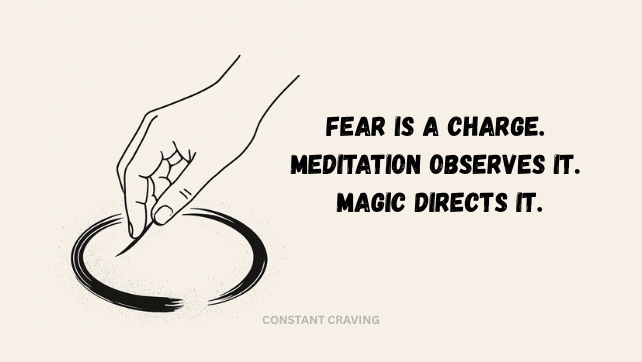
Fear is workable material. Meditation observes it. Magic shapes it.
The hybrid that emerges for me—the Bodhisattva Witch—is not a wellness niche. It’s an ethical stance. An archetype I aspire to who uses every available tool to reduce suffering: clarity, attention, ritual, protection, articulation, solidarity.
Fear as Gate, Fear as Power
Both Buddhism and witchcraft insist that transformation isn’t a performance. It isn’t glamorous or clean. Neither tradition waits for ideal conditions. Neither promises safety. They both ask for participation in a world that is always unstable.
The work begins at the point where we hesitate. That’s the gate—not because fear disappears, but because the energy of fear, directed toward care rather than self-protection, can become fuel for action.
Fear becomes material. Compassion becomes method. Emptiness becomes orientation. Risk becomes practice.
And what does that look like?
Taking one step further into clarity than is comfortable.
Speaking plainly in spaces where bypassing is the norm.
Choosing the action that aligns with our commitments rather than preserving our position.
Naming the cost of silence without pretending we’re immune to it.
Protecting our families without surrendering our ethics.
Joining others so the risks are shared rather than carried alone.
That’s my practice, anyway. It’s not heroic, it’s not pure, but it is a steady willingness to take the next responsible step in a world that keeps giving me reasons to retreat.
In spiritual solidarity,
🧿Constant Craving ✨
Wow timing! I was talking to my daughter tonight about fear being a workable material in practice and you just posted the most excellent article about it!
This is such a great piece.
And as a long term Dharma practitioner who has only been working with witchcraft the last few years ( once I realised it has always been presenting but needed attention) the particular flavour of your writing is so inspiring to me. ✨💛✨